
LA PLATA LANDSCAPE · PORT TOBACCO & SOUTHERN MARYLAND
Tree services for a healthier landscape and a safer place to call home
Trees give a property shade, character and life. Caring for them means understanding their condition, the space around them and what could be affected if a branch or tree fails.
La Plata Landscape provides pruning, tree felling and clearing, storm-damage work and stump grinding. George Jossa holds ISA Certified Arborist certification MA-6083A. See the credentials section below for the distinction between ISA certification and Maryland LTE licensing.
Request a Tree ConsultationWhy your tree professional’s credentials matter
Tree work involves living systems, heavy limbs and the property around them. Ask who will assess your trees, who will supervise the work and which credentials they hold.
Maryland Licensed Tree Expert (LTE)
Maryland DNR licenses tree experts to support consumer protection, responsible tree care and industry safety. A person may not engage in the work or business of a tree expert without the required license; employees may work under a licensed expert’s supervision.
The program includes qualification and examination requirements, insurance requirements and professional responsibilities. A written contract should identify the licensed expert and license number and clearly describe the work.
For homeowners, checking the license helps establish who is responsible for the service. Ask for current insurance information and a clear scope of work.
ISA Certified Arborist
ISA certification demonstrates knowledge across arboriculture and a commitment to professional ethics. It helps homeowners identify a professional with a foundation in tree biology and care, rather than choosing on equipment or price alone.
That knowledge informs conversations about pruning, tree health, preservation and appropriate removal. Certification is an individual professional credential; it does not replace Maryland’s LTE licensing requirements or guarantee a particular outcome.
George Jossa — ISA Certified Arborist
Certification number: MA-6083A
The right work starts with the tree
A crowded young tree, a damaged limb over a driveway and a stump in the middle of the lawn call for different solutions. We discuss the tree’s condition, access and your priorities before agreeing on the work.
Pruning & structural care
Selective pruning can remove dead or damaged branches, address rubbing growth and improve structure as young trees develop. Clearance pruning can help keep branches away from buildings, paths and driveways where appropriate.
The goal is purposeful cuts that respect the tree’s natural form—not routine topping or removing as much canopy as possible.
Tree removal & felling
Removal may be appropriate when a tree is dead, severely compromised or unsuitable for its location. The work plan considers buildings, fences, access, nearby trees and the available space.
Open-space felling and removal in confined areas require different methods. Equipment, debris handling and cleanup are defined in the proposal.
Selective clearing
Clear unwanted trees and brush while identifying the trees and vegetation to keep. Discuss access, future planting and how disturbed ground will be stabilized afterward.
For overgrown areas, invasive plant control can be part of a longer-term plan. Confirm any site-specific clearing requirements before work begins.
Storm-damage work
Broken limbs, hanging branches and partly uprooted trees need careful assessment. The first priority is understanding the hazards and deciding what can be retained, pruned or removed.
Keep people and pets away from damaged trees. For a tree touching a power line, stay clear and contact the utility; call 911 for immediate danger. Contact us to discuss site conditions and availability.
Stump grinding
Grinding reduces the remaining stump below the surrounding surface. Access, nearby utilities and your plans for the area help determine the scope.
Grinding does not remove the entire root system. Agree on treatment of grindings, backfill and lawn or planting restoration separately so the finished result matches your expectations.
Tree health & root-zone care
Thin foliage, dieback or poor growth can reflect several problems. Tree care begins with observing symptoms and reviewing soil, moisture, root disturbance and maintenance history.
Discuss mulching, watering and soil testing where appropriate. Any treatment recommendation should follow assessment of the cause.
Why careful pruning matters
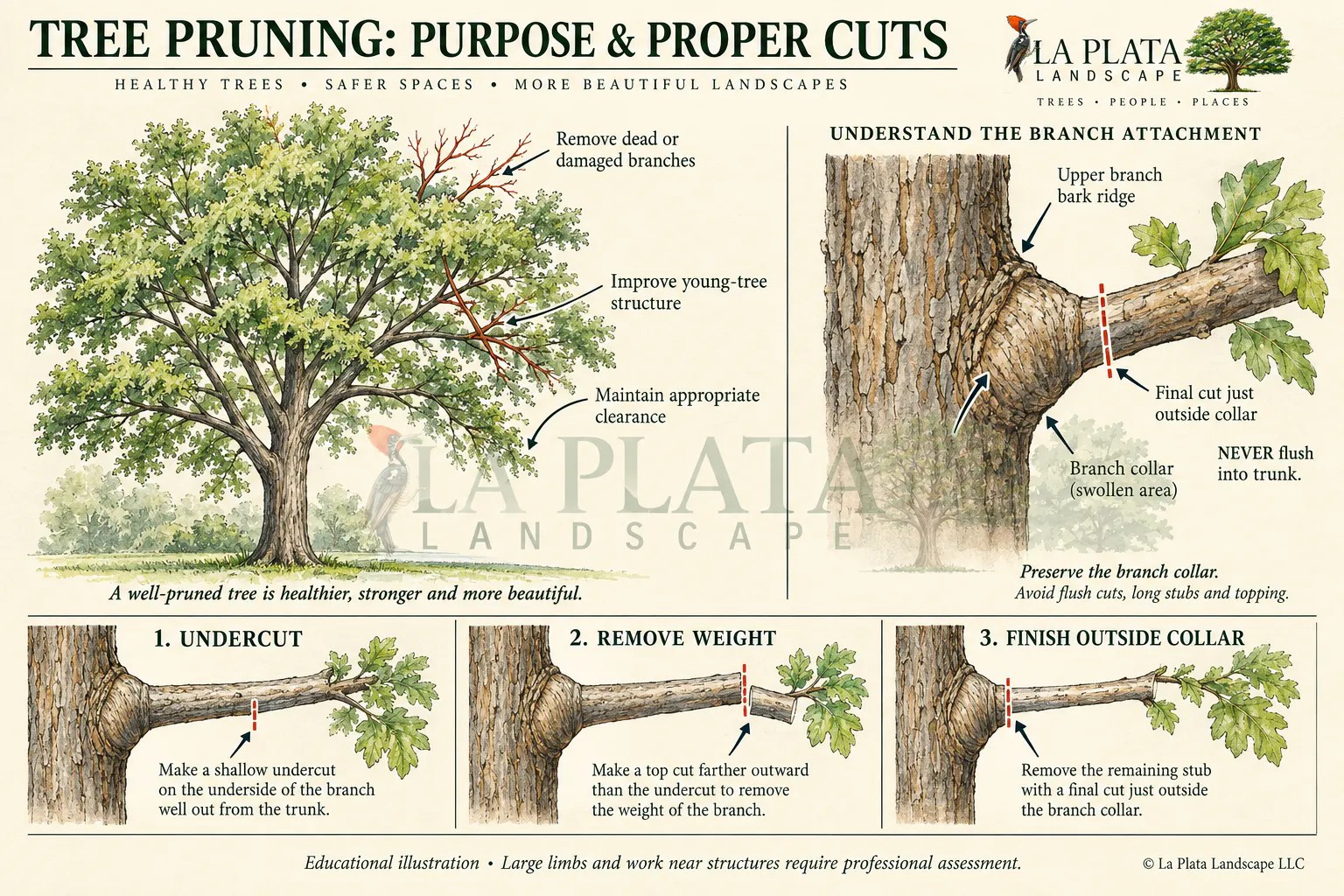
Pruning changes a living tree. Well-chosen cuts can address specific defects and clearance needs while preserving useful canopy. Unnecessary large cuts and excessive leaf removal can stress the tree.
Preserve the branch collar
The branch collar is the swelling where a branch joins its parent stem. A removal cut belongs just outside this collar and the branch bark ridge. Avoid cutting flush into the trunk or leaving a long stub.
Trees compartmentalize injuries and may grow new tissue around a wound over time; a cut does not simply heal like skin.
Remove weight before the final cut
The three-cut approach uses an initial undercut, a second cut farther out to remove the limb’s weight, and a final cut outside the collar. Separating these steps helps prevent bark tearing.
This diagram explains the principle. Large limbs, climbing and work near structures require professional planning and control.
Reduction is different from topping
Where shortening is appropriate, a branch can be reduced to a suitable lateral branch. Topping leaves indiscriminate stubs, can stimulate weakly attached shoots and may increase future problems. The amount and timing of pruning depend on species, condition and the objective.
Manage trees with the whole property in mind
Protect homes & everyday spaces
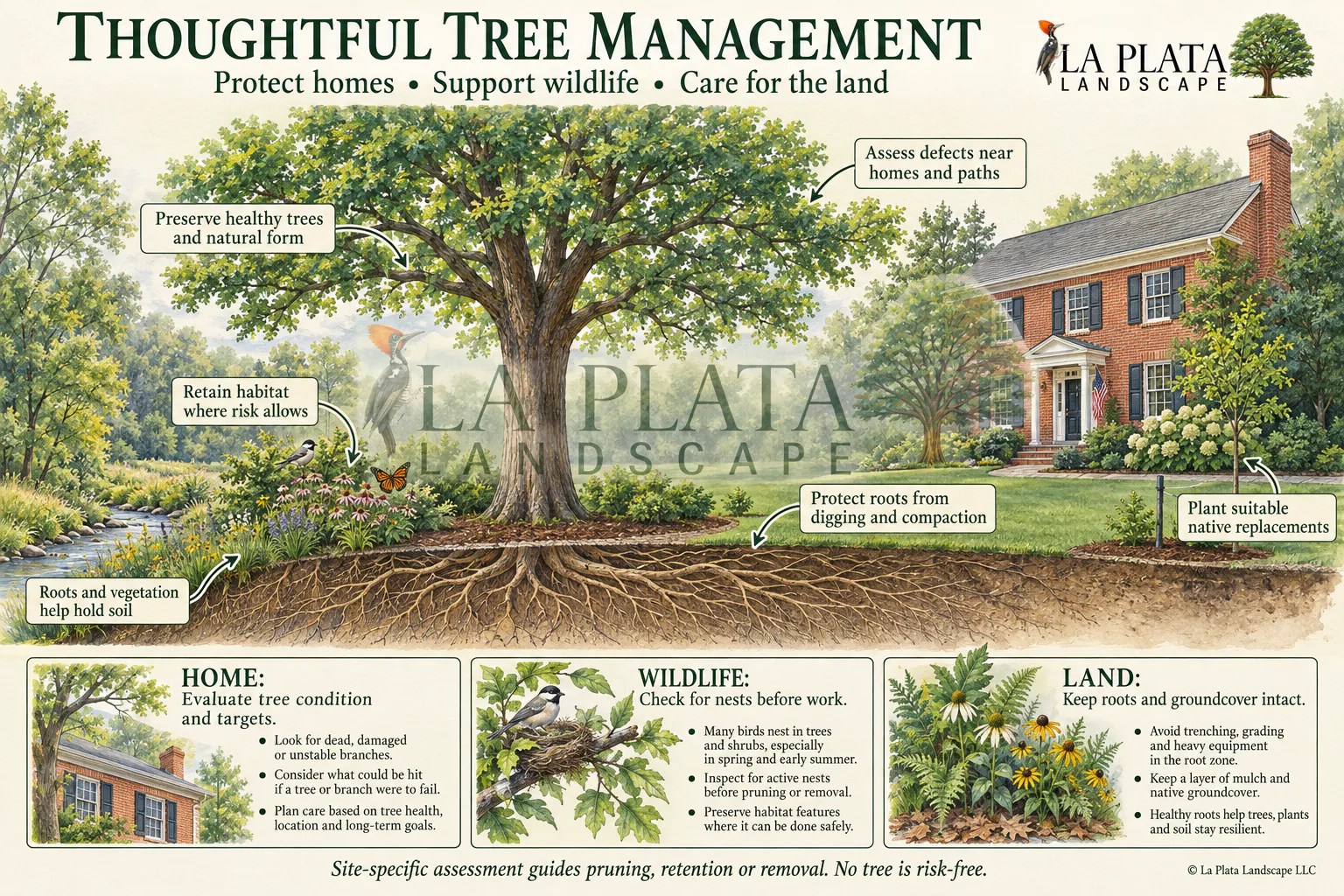
Look at both the tree and what lies beneath or beside it: a house, parked car, play area or frequently used path. Dead branches, cracks, weak unions and root changes can warrant closer assessment.
Pruning, monitoring or removal may help manage identified risks. No tree is risk-free, and an inspection cannot guarantee that a tree will never fail.
Make room for wildlife
Healthy trees provide nesting space, shelter and food. Retain suitable trees and understory where possible, and check for nests or occupied cavities before work.
Habitat wood may be retained in a suitable low-risk location. Near homes and busy areas, balance habitat value with the condition of the tree and potential consequences of failure.
Care for soil, slopes & water
Roots and vegetated ground help hold soil, while tree canopy intercepts rainfall. Protecting these features can reduce erosion and support cleaner waterways.
Avoid unnecessary soil disturbance during clearing, protect retained roots and plan groundcover or replacement planting for disturbed areas. See our drainage and rain garden guide.
Plan before construction
Trenching, grade changes, material storage and repeated equipment traffic can damage a tree’s root zone. Include retained trees in planning before adding a driveway, wall or patio.
Discuss protection areas and access routes early. When replacement is needed, select trees for mature size, site conditions and wildlife value.
What to expect
- Share the concern. Send your location, photos taken from a safe distance and a description of what has changed.
- Review the site. Discuss tree condition, access, nearby structures and the work that best fits your goals.
- Agree on the scope. Specify pruning or removal, debris handling, stump work and any ground restoration.
- Plan what comes next. Consider follow-up care, monitoring or replacement planting after the work.
Common tree-service questions
Does a leaning tree always need removal?
No. A long-standing lean and a newly developing lean are different situations. A recent change, soil movement or visible root lifting deserves prompt assessment. Keep clear if the tree appears unstable.
When should a tree be pruned?
Timing depends on the species, the reason for pruning and local pest or disease concerns. Discuss the tree before scheduling routine work. A hazardous broken branch should be assessed promptly.
Can you guarantee a tree will be safe after pruning?
No. Tree work can address identified issues, but weather, hidden defects and changing conditions remain. Continued observation and reassessment may be appropriate.
Is stump grinding included with removal?
The proposal should state whether stump grinding, removal of grindings, backfill and lawn restoration are included. Ask for the finish you want when discussing the job.
What affects the price?
Tree size and condition, access, obstacles, equipment needs, debris volume and the agreed cleanup affect the scope. Photos help start the conversation; a site review may be needed for an estimate.
Tell us about your trees
From a young shade tree to a storm-damaged limb, we’ll help you plan the next step for your property.
Book a ConsultationFurther reading: ISA: Why Topping Hurts Trees · Colorado State University: Pruning Cuts · University of Maryland: Trees and Their Benefits