
PORT TOBACCO · SOUTHERN MARYLAND
Planting & gardens that bring your outdoor space to life
A welcoming entrance, a colorful garden beside the patio, or a quieter corner under the trees—good planting starts with how you want to enjoy your property.
La Plata Landscape plans and installs trees, shrubs, perennials and garden beds with attention to growing conditions, mature size and the care they will need.
Plan Your Garden
From a fresh bed to a complete planting plan
Garden design & plant selection
Review sun, shade, moisture, soil and the views you want to frame. Choose plants for their mature size, seasonal interest and maintenance needs—not just how they look in the nursery.
For a larger property plan, connect planting with our Landscape Design services.
New beds & garden renovation
Shape new beds or refresh tired ones. Decide which established plants to keep, where crowding needs attention and how new layers will fit.
Bed preparation, weed management, edging and mulch create the foundation for a garden that is easier to care for.
Tree & shrub installation
Place shade trees, flowering understory trees and shrubs where their crowns and roots have room to develop. Consider buildings, walks, sightlines, utilities and existing trees before planting.
Set the root flare correctly and keep mulch away from trunks. Tree selection and spacing are specific to the property.
Perennial & pollinator gardens
Combine flowering plants with complementary textures and repeated groups for a garden that feels intentional. Plan a sequence of bloom rather than expecting every plant to flower at once.
Native plants can add nectar, pollen, seeds and host-plant value for local wildlife.
Rain gardens & planted drainage areas
Choose moisture-tolerant plants for areas designed to receive runoff, and different plants for their drier edges. Review soil, incoming water and a safe overflow route first.
Coordinate these areas with our Drainage Systems guide; a planting bed alone cannot solve every water problem.
Establishment & ongoing care
Discuss watering, weed control, mulch and seasonal care before installation. Newly planted natives need establishment care too.
For declining plants, soil concerns and a continuing care plan, visit Plant Health Care.
The right plant, in the right place
Maryland includes Coastal Plain, Piedmont and mountain habitats. A species native somewhere in Maryland may not be the right match for every Southern Maryland yard.
We consider local conditions, plant availability and your priorities. Use nursery-grown stock; preserve established native vegetation where practical. Plan for mature width as well as height, and discuss deer pressure and access for future maintenance.
35 flowering Maryland natives to explore
These are garden choices, not an official ranking of the most common species. Mix spring, summer and fall bloomers, and group plants that share similar light and moisture needs.

Download flowering plants — letter-size PDF
Explore all 35 plants, bloom seasons and growing conditions
Bloom periods are approximate and vary with weather, region and cultivar. “Moist” does not mean permanently flooded; confirm conditions for the selected plant.
- Black-eyed SusanRudbeckia hirta
Blooms: Summer–fall
Sun; average/dry - Orange coneflowerRudbeckia fulgida
Blooms: Summer–fall
Sun/part sun; average - Butterfly weedAsclepias tuberosa
Blooms: Summer
Sun; dry/well-drained - Swamp milkweedAsclepias incarnata
Blooms: Summer
Sun; moist/wet - Wild bergamotMonarda fistulosa
Blooms: Summer
Sun/part sun; average/dry - Scarlet bee balmMonarda didyma
Blooms: Summer
Sun/part sun; moist - Cardinal flowerLobelia cardinalis
Blooms: Summer–fall
Sun/part sun; moist/wet - Great blue lobeliaLobelia siphilitica
Blooms: Summer–fall
Sun/part shade; moist - New England asterSymphyotrichum novae-angliae
Blooms: Late summer–fall
Sun; moist - Wrinkleleaf goldenrodSolidago rugosa
Blooms: Late summer–fall
Sun/part sun; moist - Seaside goldenrodSolidago sempervirens
Blooms: Late summer–fall
Sun; coastal soils - New York ironweedVernonia noveboracensis
Blooms: Late summer–fall
Sun; moist - Hollow Joe-Pye weedEutrochium fistulosum
Blooms: Summer–fall
Sun/part sun; moist - Foxglove beardtonguePenstemon digitalis
Blooms: Late spring–summer
Sun/part sun; average - Threadleaf coreopsisCoreopsis verticillata
Blooms: Summer
Sun; well-drained - Blue false indigoBaptisia australis
Blooms: Late spring
Sun; well-drained - Yellow wild indigoBaptisia tinctoria
Blooms: Summer
Sun; dry/well-drained - Wild columbineAquilegia canadensis
Blooms: Spring
Part sun; well-drained - Virginia bluebellsMertensia virginica
Blooms: Spring
Part shade; moist - Wild geraniumGeranium maculatum
Blooms: Spring
Part shade; average/moist - Woodland phloxPhlox divaricata
Blooms: Spring
Part shade; moist - Creeping phloxPhlox stolonifera
Blooms: Spring
Part shade; moist - FoamflowerTiarella cordifolia
Blooms: Spring
Part shade/shade; moist - Green-and-goldChrysogonum virginianum
Blooms: Spring–summer
Part shade; average - American alumrootHeuchera americana
Blooms: Spring–summer
Part shade; well-drained - Virginia spiderwortTradescantia virginiana
Blooms: Spring–summer
Sun/part sun; average - White turtleheadChelone glabra
Blooms: Late summer–fall
Part sun; moist/wet - Swamp rose mallowHibiscus moscheutos
Blooms: Summer
Sun; moist/wet - Blue flag irisIris versicolor
Blooms: Late spring–summer
Sun/part sun; moist/wet - Dense blazing starLiatris spicata
Blooms: Summer
Sun; average/moist - Blue vervainVerbena hastata
Blooms: Summer–fall
Sun; moist/wet - Swamp sunflowerHelianthus angustifolius
Blooms: Late summer–fall
Sun; moist - Black cohoshActaea racemosa
Blooms: Summer
Part shade/shade; moist - Wild stonecropSedum ternatum
Blooms: Spring
Part shade; well-drained - Turk’s-cap lilyLilium superbum
Blooms: Summer
Sun/part shade; moist
25 native trees for canopy, understory & year-round structure
Large canopy trees provide long-term shade and habitat. Smaller trees add another layer, while evergreens can provide seasonal cover. Choose for the space available at maturity.
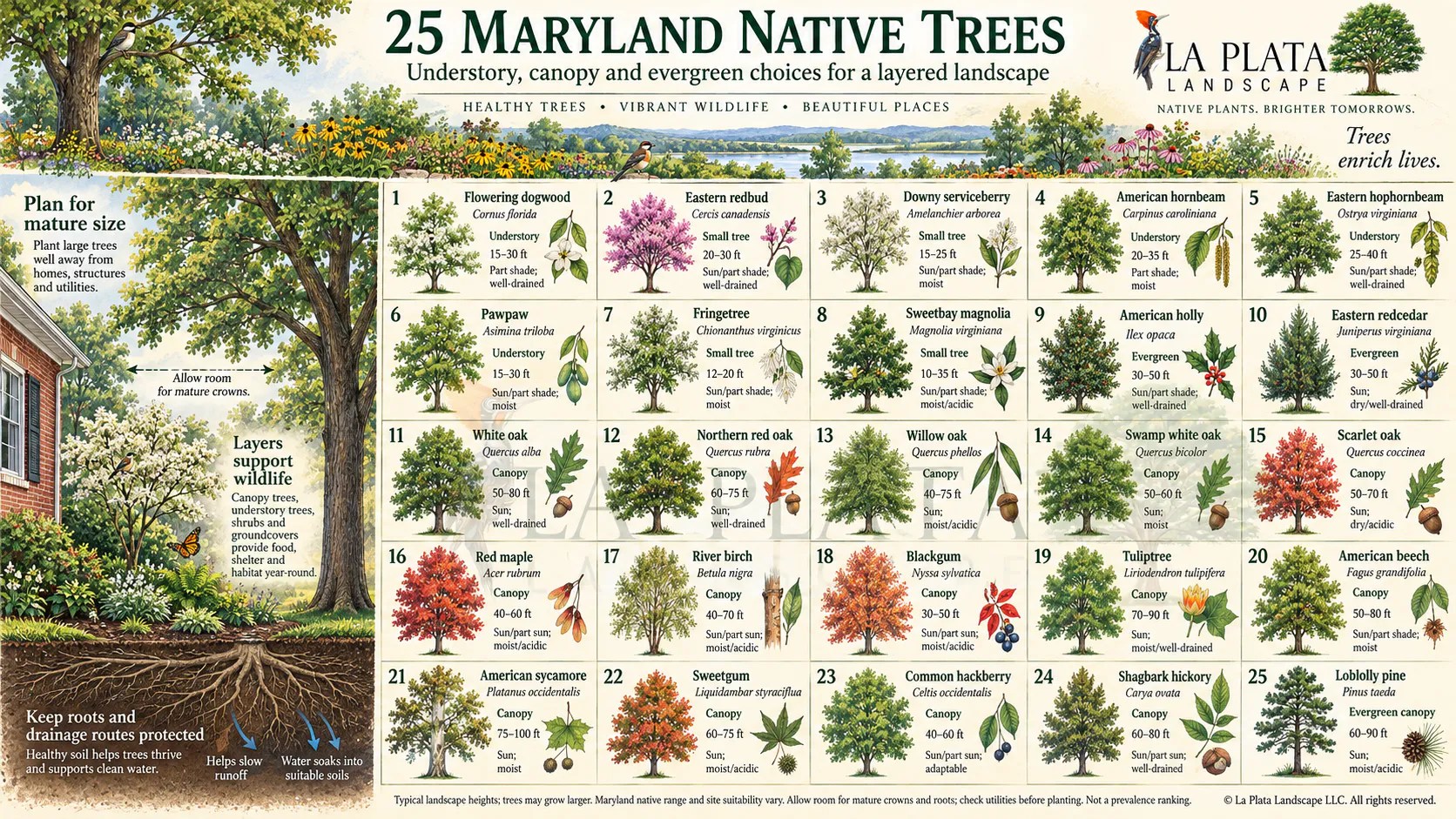
Download native trees — letter-size PDF
Explore all 25 trees, typical heights and growing conditions
Heights are typical landscape ranges, not maximums. Trees can grow larger; mature spread, root space, utilities and local conditions also guide placement. Understory describes a landscape role rather than a fixed height class.
- Flowering dogwoodCornus florida
Understory · typical height 15–30 ft
Part shade; well-drained - Eastern redbudCercis canadensis
Small tree · typical height 20–30 ft
Sun/part shade; well-drained - Downy serviceberryAmelanchier arborea
Small tree · typical height 15–25 ft
Sun/part shade; moist - American hornbeamCarpinus caroliniana
Understory · typical height 20–35 ft
Part shade; moist - Eastern hophornbeamOstrya virginiana
Understory · typical height 25–40 ft
Sun/part shade; well-drained - PawpawAsimina triloba
Understory · typical height 15–30 ft
Sun/part shade; moist - FringetreeChionanthus virginicus
Small tree · typical height 12–20 ft
Sun/part shade; moist - Sweetbay magnoliaMagnolia virginiana
Small tree · typical height 10–35 ft
Sun/part shade; moist/acidic - American hollyIlex opaca
Evergreen · typical height 30–50 ft
Sun/part shade; well-drained - Eastern redcedarJuniperus virginiana
Evergreen · typical height 30–50 ft
Sun; dry/well-drained - White oakQuercus alba
Canopy · typical height 50–80 ft
Sun; well-drained - Northern red oakQuercus rubra
Canopy · typical height 60–75 ft
Sun; well-drained - Willow oakQuercus phellos
Canopy · typical height 40–75 ft
Sun; moist/acidic - Swamp white oakQuercus bicolor
Canopy · typical height 50–60 ft
Sun; moist - Scarlet oakQuercus coccinea
Canopy · typical height 50–70 ft
Sun; dry/acidic - Red mapleAcer rubrum
Canopy · typical height 40–60 ft
Sun/part sun; moist/acidic - River birchBetula nigra
Canopy · typical height 40–70 ft
Sun/part sun; moist/acidic - BlackgumNyssa sylvatica
Canopy · typical height 30–50 ft
Sun/part sun; moist/acidic - TuliptreeLiriodendron tulipifera
Canopy · typical height 70–90 ft
Sun; moist/well-drained - American beechFagus grandifolia
Canopy · typical height 50–80 ft
Sun/part shade; moist - American sycamorePlatanus occidentalis
Canopy · typical height 75–100 ft
Sun; moist - SweetgumLiquidambar styraciflua
Canopy · typical height 60–75 ft
Sun; moist/acidic - Common hackberryCeltis occidentalis
Canopy · typical height 40–60 ft
Sun/part sun; adaptable - Shagbark hickoryCarya ovata
Canopy · typical height 60–80 ft
Sun/part sun; well-drained - Loblolly pinePinus taeda
Evergreen canopy · typical height 60–90 ft
Sun; moist/acidic
Plan large trees well away from conflicts with structures and utilities. Inspect existing trees before changing grades or digging near roots. Our Tree Services guide explains pruning and tree management.
A garden connects your home to the land and water around it
Plant selection works together with soil care, grading and drainage. Roots and groundcover help hold soil; planted areas can slow runoff and let some rain soak in where conditions allow. Thoughtful fertilizer use helps limit unnecessary nutrients leaving the property.
The Port Tobacco River drains into the Potomac River, which reaches the Chesapeake Bay. The Patuxent River also flows to the Chesapeake Bay. Your property's watershed determines where its runoff travels.
Support wildlife
Offer a variety of flowers, foliage, seeds, berries and shelter through the seasons. Native host plants help support insects that are part of the food web, including food for birds.
Protect land & plan around the house
Cover exposed soil, preserve healthy roots and leave drainage paths open. Allow mature plants room around walls, roofs and walks, and direct runoff away from foundations. Planting supports a sound property plan; it cannot guarantee protection from floods or tree failure.
How we bring your garden together
- Start with your priorities. Share photos, your location, favorite colors and how you use the space.
- Read the site. Review light, moisture, existing vegetation and soil; test where it will help guide decisions.
- Agree on a planting plan. Set the layout, plant choices, quantities, preparation and project scope. Work can be phased.
- Prepare and install. Coordinate access and utility marking, prepare beds and install at suitable depths and spacing.
- Plan establishment care. Discuss watering, monitoring and maintenance so the planting has support as it grows.
Before comparing proposals, compare the scope and contractor credentials as well as price.
Questions about planting & gardens
Does the whole garden need to be replaced?
No. Healthy, well-placed plants can anchor a renovation. We can discuss filling gaps, reducing crowding or rebuilding one area at a time.
Are native gardens maintenance-free?
No. Appropriate plant selection helps, but watering during establishment, weed control and seasonal upkeep still matter.
Can every plant in the guide grow in my yard?
No. The lists cover different conditions and regions. A dry sunny bed needs a different palette from a damp woodland edge. Final choices depend on your site.
Can a garden help with standing water?
Sometimes a designed rain garden can be part of the answer. Persistent standing water near the home needs a drainage assessment before selecting plants.
Related landscape care
Tree services
Plant health care
Lawn maintenance & mowing
Discuss routine mowing and care alongside your garden maintenance.
Lawn restoration, seeding & sod
Review bare or thinning areas, soil preparation, aeration, seeding and sod options. Amendments depend on site needs.
Soil testing
Use test results to guide nutrient and pH decisions before applying fertilizer or lime.
Let’s make room for a garden you enjoy
Tell us about your property and the planting you have in mind.
Book a Consultation